
Semaglutide Weight Loss, Supervised by Your Physician
At Celestique MD, semaglutide isn’t a prescription you pick up and figure out on your own. It’s one part of a weight management plan built around your medical history, your lab work, and the full hour we spend together at every visit.
Dr. Widian Jubair prescribes both Ozempic and Wegovy. She’s board-certified in internal medicine, with advanced training from Harvard Medical School in Obesity Medicine, Lifestyle Medicine, and Women’s Health and Menopause. She treats weight as a medical condition, because it is one — and because the hormonal and metabolic factors underneath it rarely resolve themselves with a weekly injection alone.

What semaglutide is, and how it works
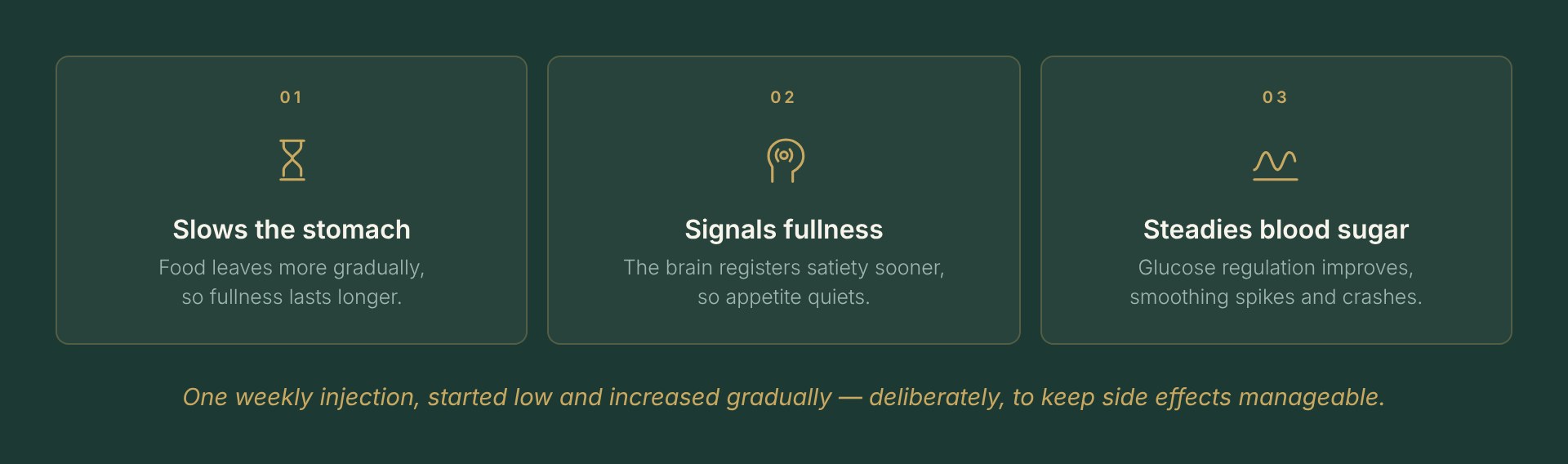
Semaglutide is a GLP-1 receptor agonist — a medication that mimics a hormone your body already produces. It works on more than one front: it slows how quickly your stomach empties, signals fullness to the brain, and helps regulate blood sugar.
For most patients the practical effect is a quieter appetite. You feel full sooner, and you stay full longer.
It’s given as a once-weekly injection under the skin, starting at a low dose and increasing gradually over several weeks. That slow build is deliberate. It gives your body time to adjust and keeps side effects manageable.
Why the supervision matters more than the prescription
Semaglutide is easy to get now. Online pharmacies, med spas, telehealth services that will ship you a vial after a five-minute questionnaire.
What those options skip is the medicine.
Before you start, a few questions are worth answering. Is your thyroid functioning normally? Where are your hormone levels, particularly if you’re perimenopausal? Is something metabolic driving the weight that semaglutide by itself won’t touch? Is there anything in your history that makes this medication a poor fit for you specifically?
Those answers change the plan. Sometimes they change the medication. Occasionally they reveal that the weight was never the first problem to solve.
Weight, hormones, and what changes in midlife
If you’re in your forties or fifties and the weight arrived without any change in how you eat or move, you aren’t imagining it.
Shifting estrogen levels change where the body stores fat, affect how easily lean muscle is maintained, and influence insulin sensitivity. For a lot of women, the weight that shows up in perimenopause is a hormonal event rather than a willpower problem.
That distinction matters for treatment. Semaglutide may be part of the answer. So may hormone therapy. Often the conversation worth having is about both, and whether one makes the other work better.
This is the overlap Dr. Jubair trained in specifically, and it’s the reason weight and menopause aren’t booked as two separate appointments here.
What treatment actually looks like
A full hour to start
Your first appointment covers your history, your current medications, what you’ve already tried, and what you’re hoping for. Lab work is ordered where it’s needed.
Results and a plan, together
Dr. Jubair walks you through what the labs show, whether semaglutide fits, and what belongs alongside it.
Starting treatment
Prescription, injection training, and a clear picture of what the first few weeks tend to feel like.
Ongoing care
Regular check-ins, dose adjustments as needed, and direct access to your physician when something comes up between visits — not a portal message that gets answered in four days.
Side effects and who shouldn't take it
The most common side effects are gastrointestinal — nausea, constipation, diarrhea, and abdominal discomfort. They tend to appear early and ease as the body adjusts, and careful dose titration is part of how we keep them manageable.
Less common but more serious risks include pancreatitis and gallbladder problems.
Semaglutide isn’t appropriate for everyone. It isn’t used by anyone with a personal or family history of medullary thyroid carcinoma or Multiple Endocrine Neoplasia syndrome type 2, and it isn’t used in pregnancy.
This is exactly the sort of thing worth going through with a physician who knows your whole history, rather than a form you fill out online.
What it costs
Our membership pricing is published on this site, which is less common than it should be.
Membership covers your visits, your direct line to Dr. Jubair, and the ongoing management of your plan. The cost of the medication itself is separate and depends on which formulation you and Dr. Jubair decide on together.
No insurance billing. No surprise invoice six weeks later. No charge for a question that takes five minutes to answer.
Common Questions
Do I need insurance?
No. Celestique MD is a membership practice and doesn’t bill insurance. Pricing is published, and you’ll know what you’re paying before you commit to anything.
How soon will I notice a difference?
Appetite changes often show up within the first few weeks. Weight change is more gradual and varies considerably from one person to the next. Dr. Jubair won’t promise you a number, and it’s worth being cautious of anyone who does.
What's the difference between Ozempic, Wegovy, and compounded semaglutide?
Ozempic and Wegovy are both brand-name semaglutide made by Novo Nordisk. Ozempic is FDA-approved for type 2 diabetes and Wegovy for chronic weight management. Dr. Jubair prescribes both. Compounded semaglutide is prepared by a compounding pharmacy and is not FDA-approved — a real difference in oversight, and one worth discussing before you decide.
How is semaglutide different from Mounjaro or Zepbound?
Those are brand names for tirzepatide, a different medication that Dr. Jubair also prescribes. The two work along related but not identical pathways, and the right choice depends on your history, your other conditions, and how your body responds.
Do I have to stay on it forever?
For some patients it’s a long-term medication. For others it’s a bridge while other changes take hold. Obesity is a chronic condition, and stopping often leads to regain — which is a conversation worth having before you start rather than afterward.
Can I take semaglutide during menopause, or alongside hormone therapy?
Often, yes, and for many women the two are worth considering together. Dr. Jubair has advanced training in both obesity medicine and menopause care, so this gets handled as one plan instead of two.
Where are you located?
20991 E Smoky Hill Road, Suite 150, Aurora, CO 80015 — serving Aurora, Centennial, and the southeast Denver metro.
Start with a conversation
If you’re considering semaglutide and want a physician’s read on whether it fits — and what else might belong alongside it — that’s the appointment to book.
An hour, your actual history, and a straight answer.
Request a consultation · (720) 975-8044

Empowering patients in Aurora, CO with personalized care. Because true health begins with a doctor who listens.
Our Services
Contact Us
- 20991 E Smoky Hill Rd, Suite 150, Centennial, Colorado, 80015
- widianjubair@celestiquemd.org
- (720) 975-8044
- 720-809-8430